South to the Lowcountry
An HPS/MAG Trip Through the Carolinas and Virginia • March 22–30, 2026
When a group of plant enthusiasts is offered a seat on a bus heading toward the gardens and historic landscapes of the Carolina Lowcountry in late March, the answer is easy. For the HPS/MAG group that departed on March 22nd, it was equally easy to settle in — because behind the wheel was Rick Bandell, a veteran of HPS road trips, whose calm competence has a way of turning miles of highway into pleasant anticipation. A mix of familiar faces and welcome newcomers made up the group, and as our tour leader Janice Thomas — who organizes HPS Domestic Trips — predicted on the first day out, we'd all become fast friends before the week was done.
Day One: Southward Bound
With Rick navigating, we headed south, stretching our legs at a rest stop in Rocky Mount, North Carolina before continuing toward the coast. Our home base for the Charleston portion of the trip would be the Indigo Inn, a charming hotel in the city's French Quarter whose rooms overlook an open-air, three-story European-style atrium — a peaceful central courtyard with a fountain where we could unwind at the end of each long and full day. The real adventure lay just ahead.
Day Two: Cypress Gardens and the City of Charleston
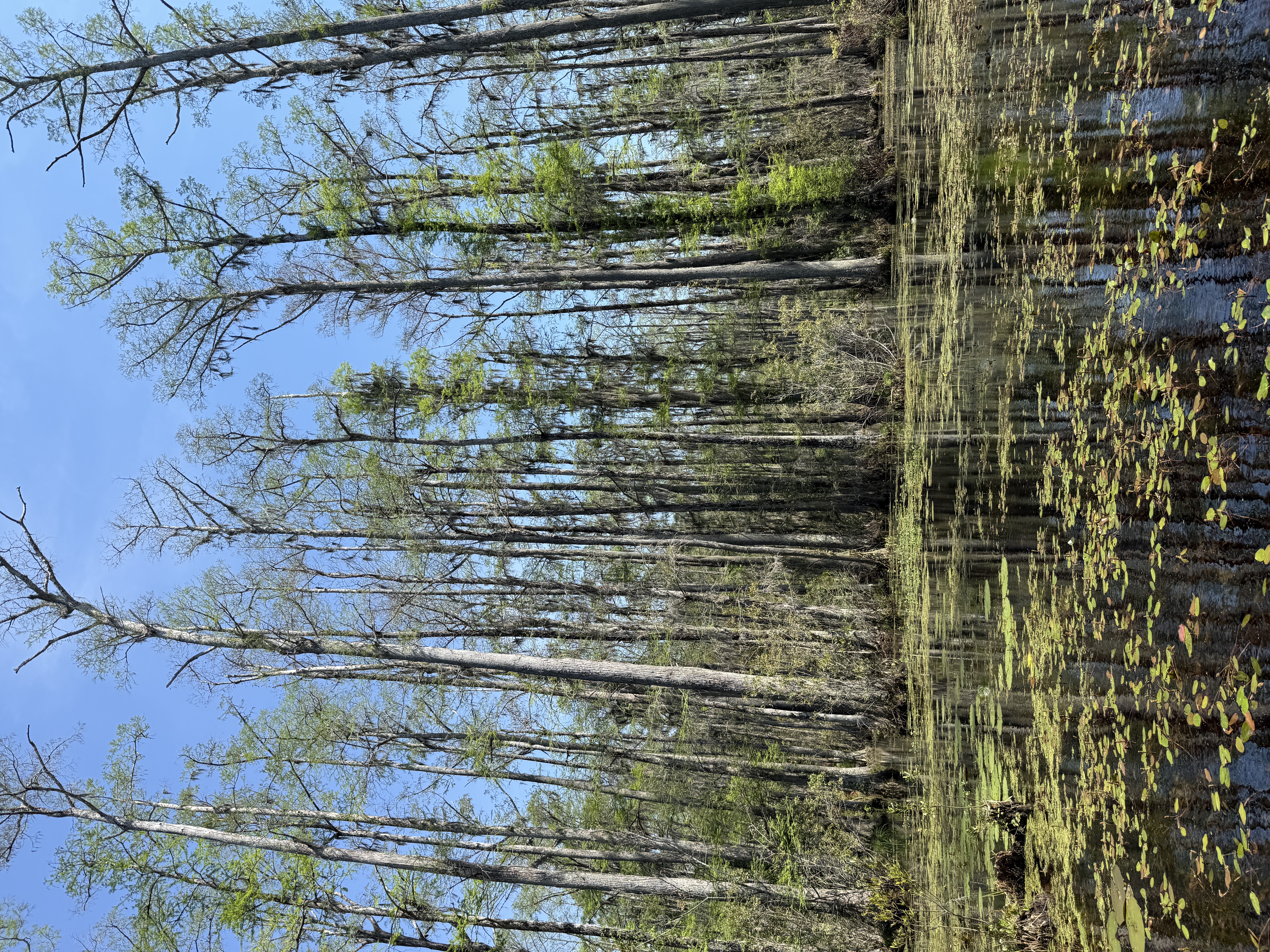 Our first botanical stop was Cypress Gardens in Berkeley County, South Carolina — a place that rewards visitors Our first botanical stop was Cypress Gardens in Berkeley County, South Carolina — a place that rewards visitors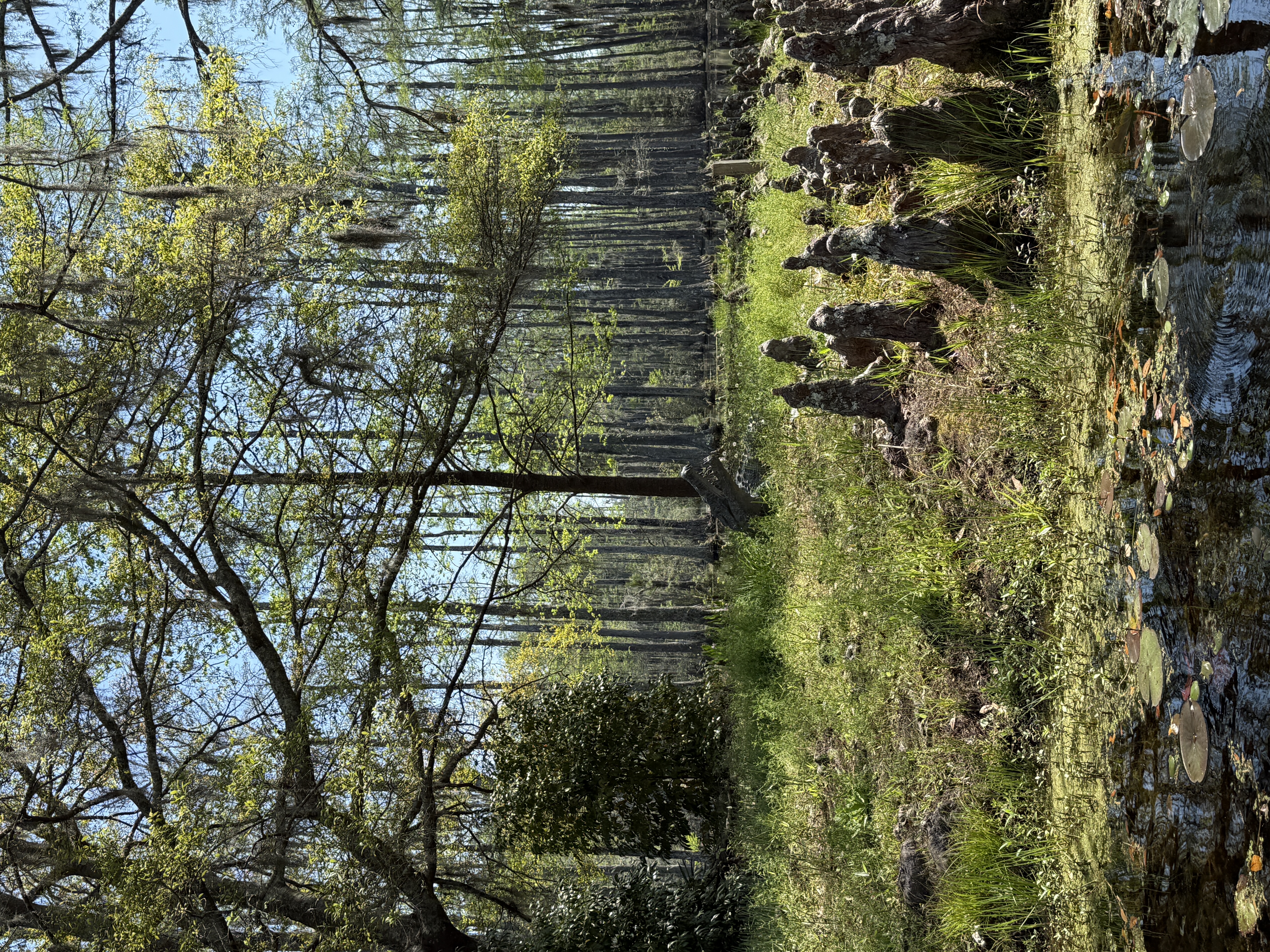 willing to slow down and look. Those who chose to paddle had a 45-minute self-guided rowboat tour through the cypress swamp, gliding past duckweed, iris, and pickerel weed while Tupelo and bald cypress draped in Spanish moss rose overhead. Others walked the garden's four-mile loop, taking in the butterfly house and the "Swamparium," an aquarium and reptile exhibit that gave an up-close look at the aquatic life sharing these waters. willing to slow down and look. Those who chose to paddle had a 45-minute self-guided rowboat tour through the cypress swamp, gliding past duckweed, iris, and pickerel weed while Tupelo and bald cypress draped in Spanish moss rose overhead. Others walked the garden's four-mile loop, taking in the butterfly house and the "Swamparium," an aquarium and reptile exhibit that gave an up-close look at the aquatic life sharing these waters.
One feature that drew particular attention was the cypress knees — those strange, conical woody projections that erupt from the shallows around the base of bald cypress trees. Scientists believe they may help aerate roots, anchor the tree in soft muddy soil, or reduce erosion by catching sediment, though their function remains an open question that has puzzled botanists for more than two centuries. What's not in dispute is how otherworldly they look, rising from the dark water like sentinels around the base of trees that can live to be 600 years or more.
By afternoon we had arrived in Charleston — greeted, apparently, by record-breaking heat — and settled into the Indigo Inn, which would serve as home base for the next four nights. The location proved ideal: restaurants, shops, and historic sites all within easy walking distance. And of course, no visit to Charleston is complete without a stop at the iconic Pineapple Fountain overlooking the Cooper River.
A brief note on history: long before it was Charleston, this was Charles Town — founded in 1670 and quickly becoming one of the most prosperous ports in the American colonies. Much of that prosperity was built on two crops above all: rice, particularly the celebrated Carolina Gold variety, and indigo, which produced the vivid blue dye that colonial merchants shipped to Europe in vast quantities. Both crops were cultivated through the labor of enslaved people, a fact that the city and its many institutions are increasingly and rightly centering in how this history is told.
The first of many sweet sustenance stops came courtesy of Joanne Patti's almond biscotti — because the best garden tours, as any HPS member knows, are also well-fed ones. More treats lay ahead.
Day Three: Magnolia Plantation & Gardens
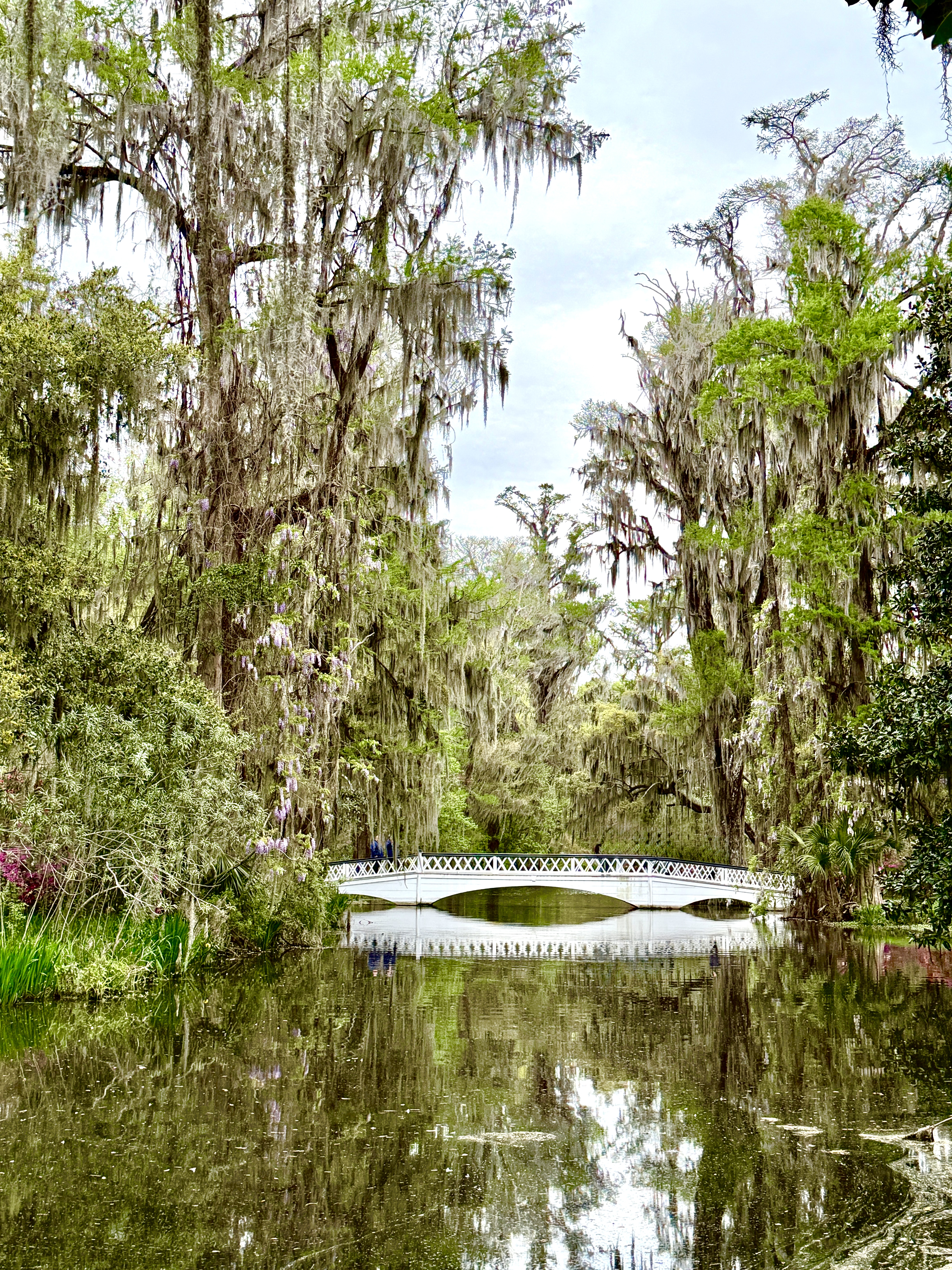 We arrived at Magnolia Plantation not by the steamboat that once carried visitors from Charleston — when the gardens first opened to the public in 1871, We arrived at Magnolia Plantation not by the steamboat that once carried visitors from Charleston — when the gardens first opened to the public in 1871,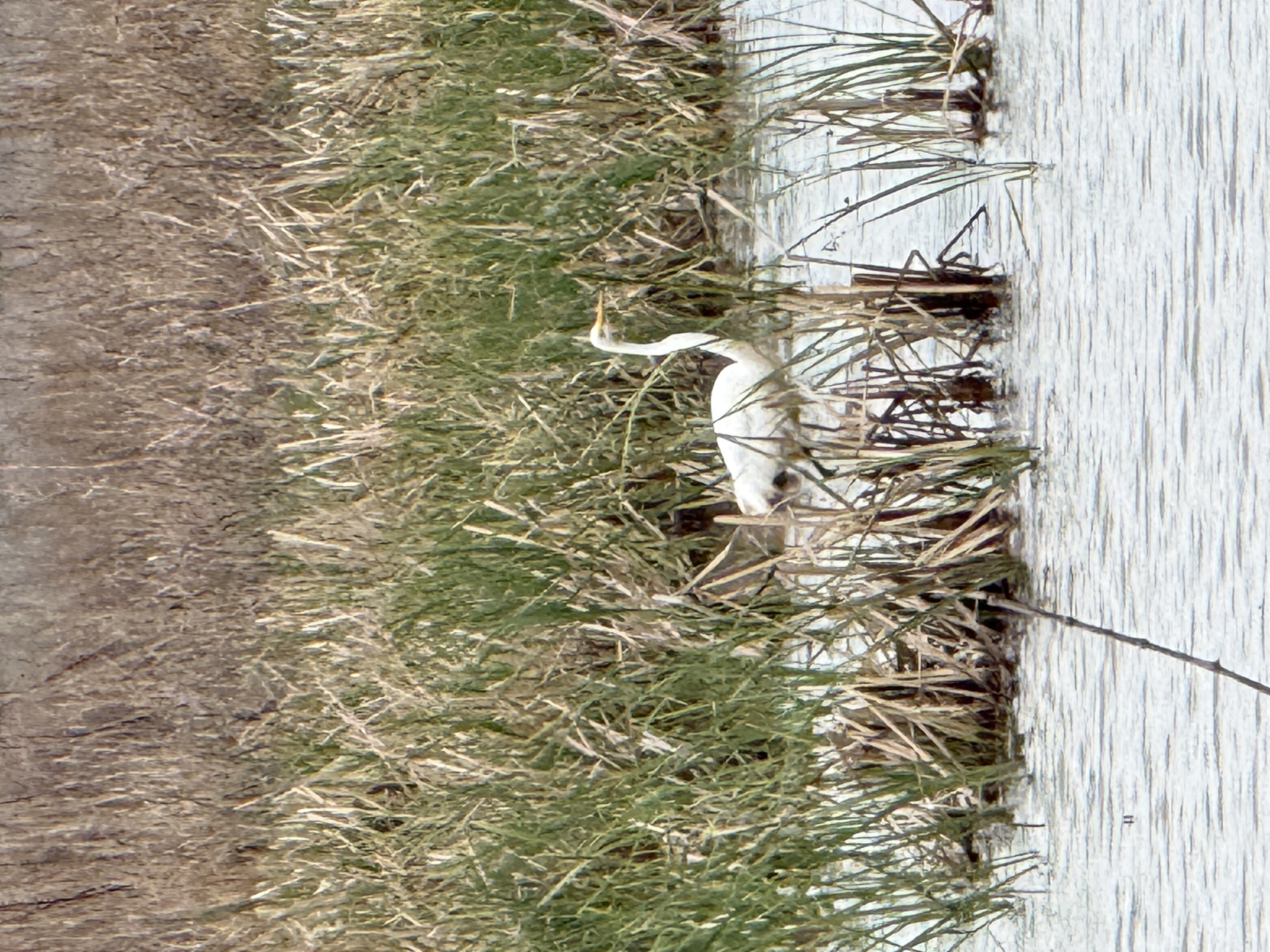 visitors arrived by steamboat and were guided by formerly enslaved individuals — but by our own bus, which felt both practical and a little less romantic. No matter. The gardens delivered. visitors arrived by steamboat and were guided by formerly enslaved individuals — but by our own bus, which felt both practical and a little less romantic. No matter. The gardens delivered.
The plantation's history begins in the late 17th century, when the Drayton family expanded a 400-acre parcel along the Ashley River into nearly 1,700 acres, wealth built on Carolina Gold Rice and the labor of enslaved people. In the 1840s, Reverend John Grimké Drayton created the Romantic-style gardens — introducing azaleas and camellias outdoors for the first time in South Carolina's climate — as a gift of sorts to his wife, to help her adjust to Lowcountry life.
The day had turned cold, but hardy HPS members were undeterred. After the house and nature tours, we boarded a pontoon boat on the Ashley River, where the rewards were considerable: alligators, anhingas, cormorants, and a roster of waterbirds that kept cameras busy. Back on land, the allées of Spanish moss-draped oaks — some of extraordinary age and girth — offered the quintessential image of a Lowcountry grand estate.
elegant waterbirds spotted from the pontoon boat at Magnolia Plantation.
As for bloom: the camellias were largely past their peak, but the azaleas were putting on a show. March at Magnolia brings Indica azaleas in full bloom alongside daffodils, Japanese snowball viburnum, and native red buckeye, and the leggy azaleas in shades of pink, coral, and burgundy provided vivid color against the lush green landscape.
Spirits were further lifted by Liz Garnett's Easy Crunchies — passed along the bus seats with the quiet generosity that would come to characterize our journey.
Day Four: The Ashley River Corridor
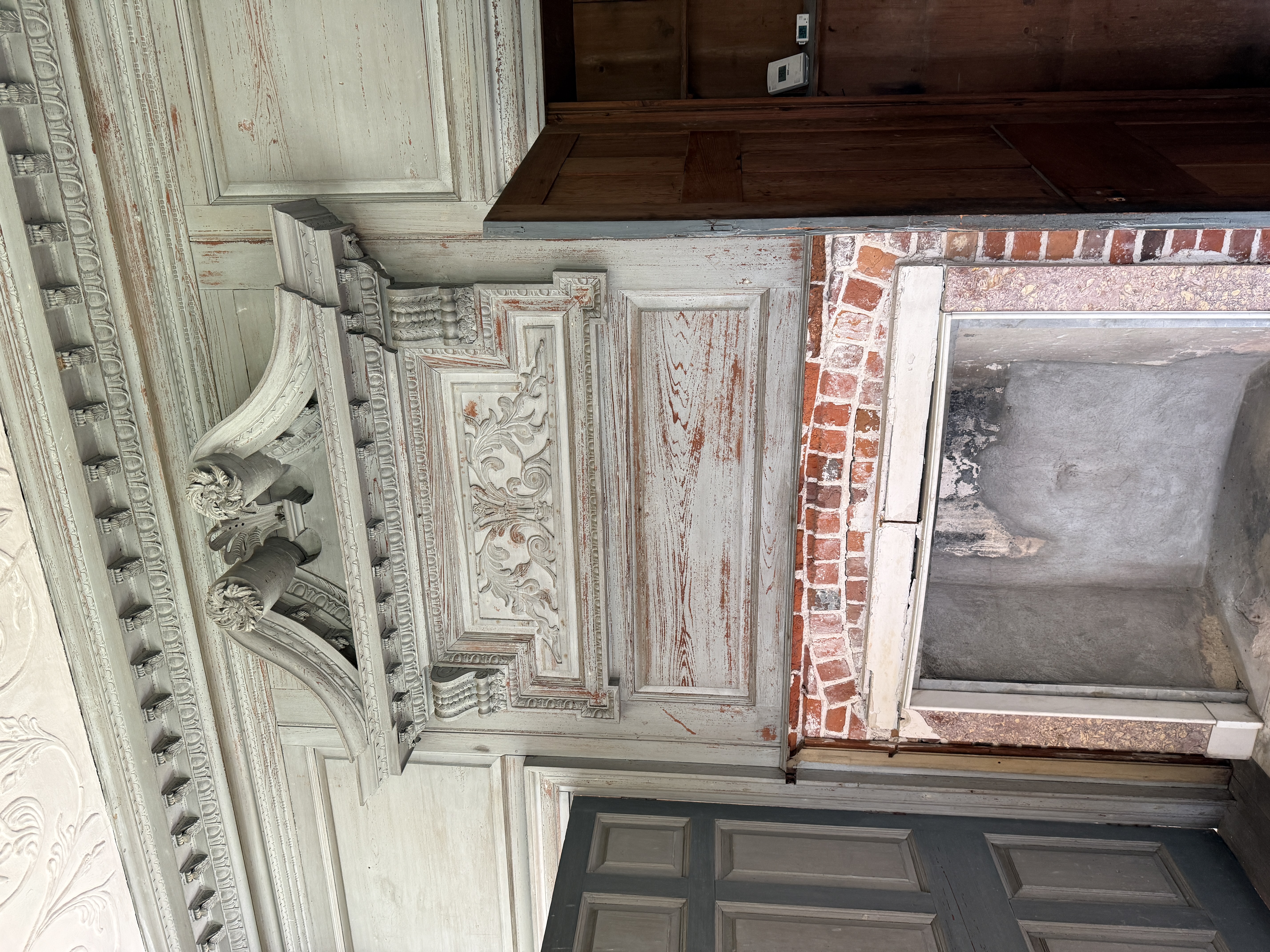 Day Four brought another cool, overcast morning — the kind that turns out to be ideal for walking historic grounds without the distraction of sweat. Our first stop was Drayton Hall, just up Ashley River Road from Magnolia. Drayton Hall is considered the earliest and finest example of Palladian architecture in the United States, and what makes it particularly striking among historic properties is what hasn't been done to it. Rather than restore the house to any single period, the decision was made to stabilize it as acquired from the Drayton family in the 1970s, preserving seven generations of history within its walls. There are no period room recreations, no roped-off velvet chairs — just the building itself, speaking across three centuries. Day Four brought another cool, overcast morning — the kind that turns out to be ideal for walking historic grounds without the distraction of sweat. Our first stop was Drayton Hall, just up Ashley River Road from Magnolia. Drayton Hall is considered the earliest and finest example of Palladian architecture in the United States, and what makes it particularly striking among historic properties is what hasn't been done to it. Rather than restore the house to any single period, the decision was made to stabilize it as acquired from the Drayton family in the 1970s, preserving seven generations of history within its walls. There are no period room recreations, no roped-off velvet chairs — just the building itself, speaking across three centuries.
The afternoon belonged to Middleton Place, and what an afternoon it was. America's oldest landscaped gardens, located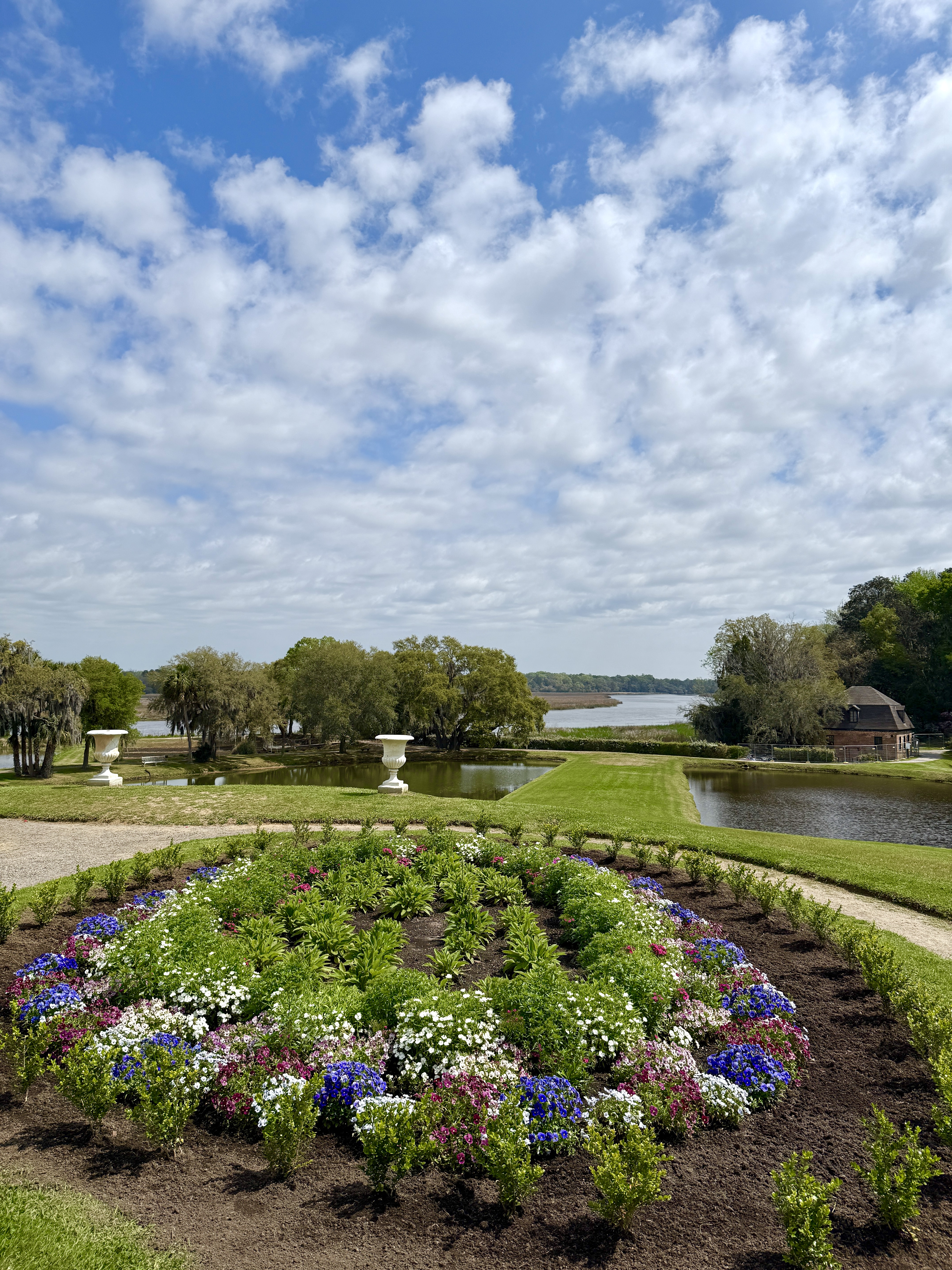 along the Ashley River, Middleton Place is a National Historic Landmark encompassing historic gardens, a house museum, and plantation stableyards that together tell a layered story of founding-era ambition and the enslaved labor that made it possible. along the Ashley River, Middleton Place is a National Historic Landmark encompassing historic gardens, a house museum, and plantation stableyards that together tell a layered story of founding-era ambition and the enslaved labor that made it possible.
We began, happily, with lunch — a thoroughly traditional Southern spread of crispy fried chicken, collards, mac and cheese, and pecan pie that set exactly the right tone for an afternoon in the Lowcountry. A knowledgeable and hospitable guide then oriented us to the scope of what lay ahead: 100 acres in total, 65 of them formally landscaped, planted with some 35,000 azaleas and 10,000 camellias. The numbers alone are staggering.
Henry Middleton began creating the gardens in 1741, following the grand classical principles of André Le Nôtre — the designer behind the gardens at Versailles — with allées, vistas, geometric canals, and garden rooms formed by clipped hedges. The first camellias in America were brought here by French botanist André Michaux around 1786, and one of his original plants, the Reine-des-Fleur, still grows on the grounds today.
In the informal gardens, the camellias were in full abundance, and we observed air layering — also known as 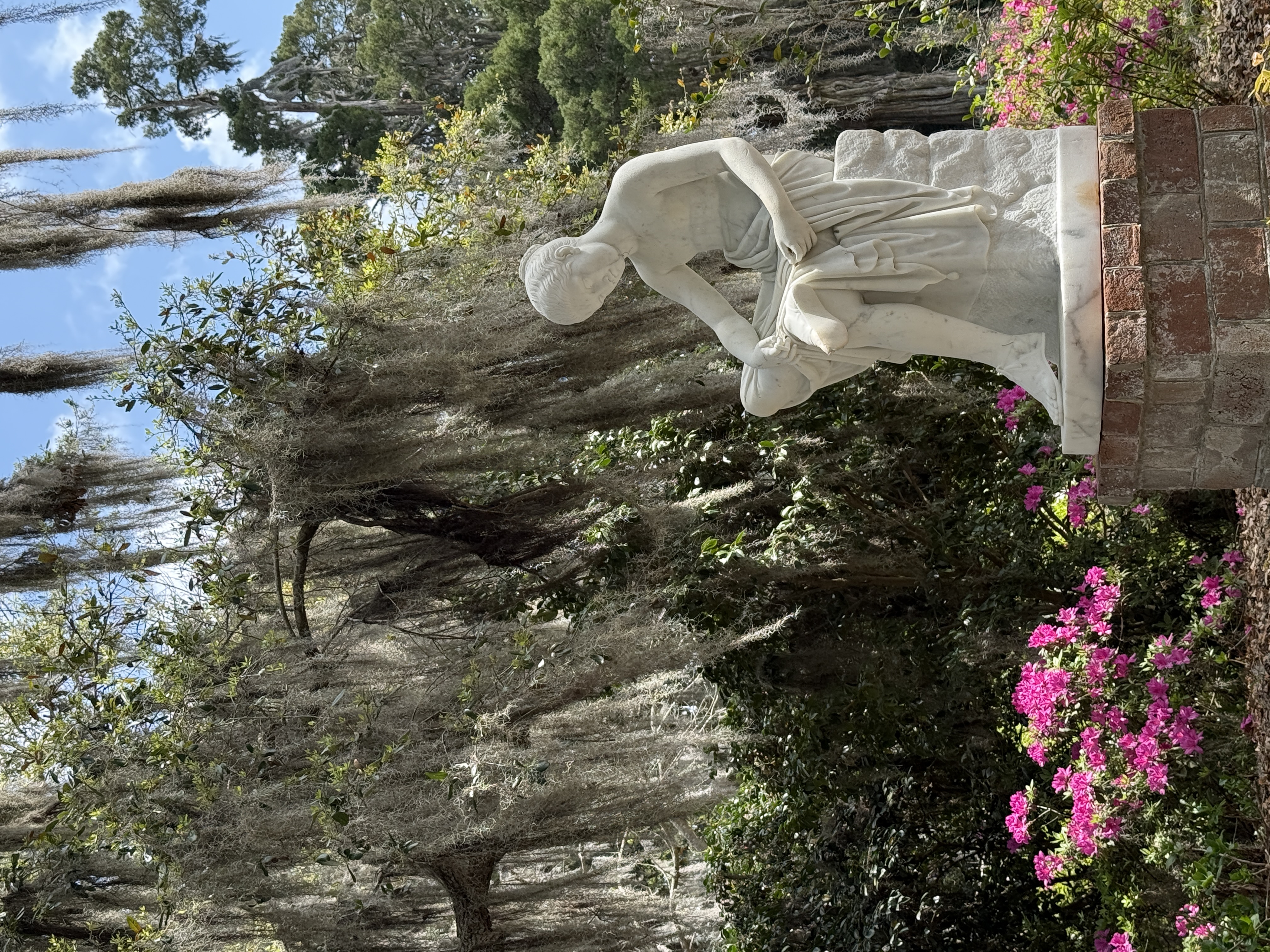 marcottage — in practice on a camellia: a technique that encourages roots to form on a stem while still attached to the parent plant, before it is severed and potted on. The reflection of bald cypress (Taxodium distichum) and azaleas mirrored in the still pond water was one of those images that stops you mid-step. marcottage — in practice on a camellia: a technique that encourages roots to form on a stem while still attached to the parent plant, before it is severed and potted on. The reflection of bald cypress (Taxodium distichum) and azaleas mirrored in the still pond water was one of those images that stops you mid-step.
Presiding serenely over the azalea pool is the garden's most beloved resident: the Wood Nymph. This marble statue, carved around 1810 by German sculptor Johan Rudolf Schadow, is the iconic symbol of Middleton Place. When Union troops advanced in 1865 and burned the plantation buildings, the Wood Nymph was buried in the earth to protect her — and emerged from the war unscathed. She now sits surrounded by azaleas, a quiet survivor of everything history has thrown at this place.
Mary Haskins's vanilla-bean sablé cookies — buttery, delicate, and rolled in sparkling sanding sugar — were the perfect companion to an afternoon of grand gardens.
Day Five: On the Water and Through the Centuries
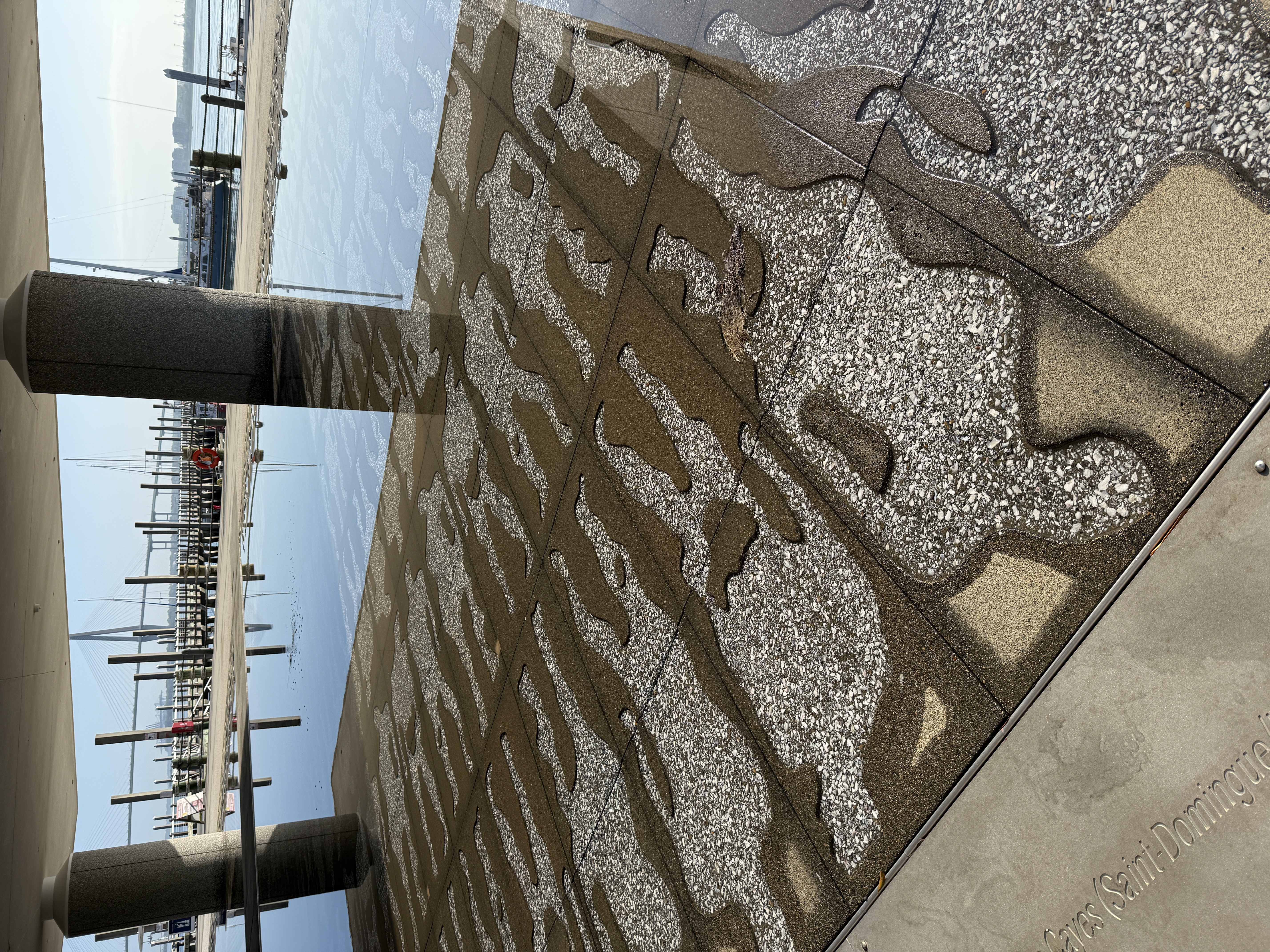 Day Five dawned sunny and cool — a gift after the chill of earlier days — and the group headed to the marina for a morning on the water. But first, those who wished had the option of visiting the International African American Museum, one of Charleston's newest and most significant cultural institutions. The IAAM sits on historic Gadsden's Wharf on the Cooper River — the last major disembarkation point for Africans during the transatlantic slave trade in North America, where an estimated 100,000 men, women, and children arrived and were sold into slavery between 1783 and 1808. The $120 million building is constructed on pillars so as not to touch this sacred ground, a design choice as deliberate and Day Five dawned sunny and cool — a gift after the chill of earlier days — and the group headed to the marina for a morning on the water. But first, those who wished had the option of visiting the International African American Museum, one of Charleston's newest and most significant cultural institutions. The IAAM sits on historic Gadsden's Wharf on the Cooper River — the last major disembarkation point for Africans during the transatlantic slave trade in North America, where an estimated 100,000 men, women, and children arrived and were sold into slavery between 1783 and 1808. The $120 million building is constructed on pillars so as not to touch this sacred ground, a design choice as deliberate and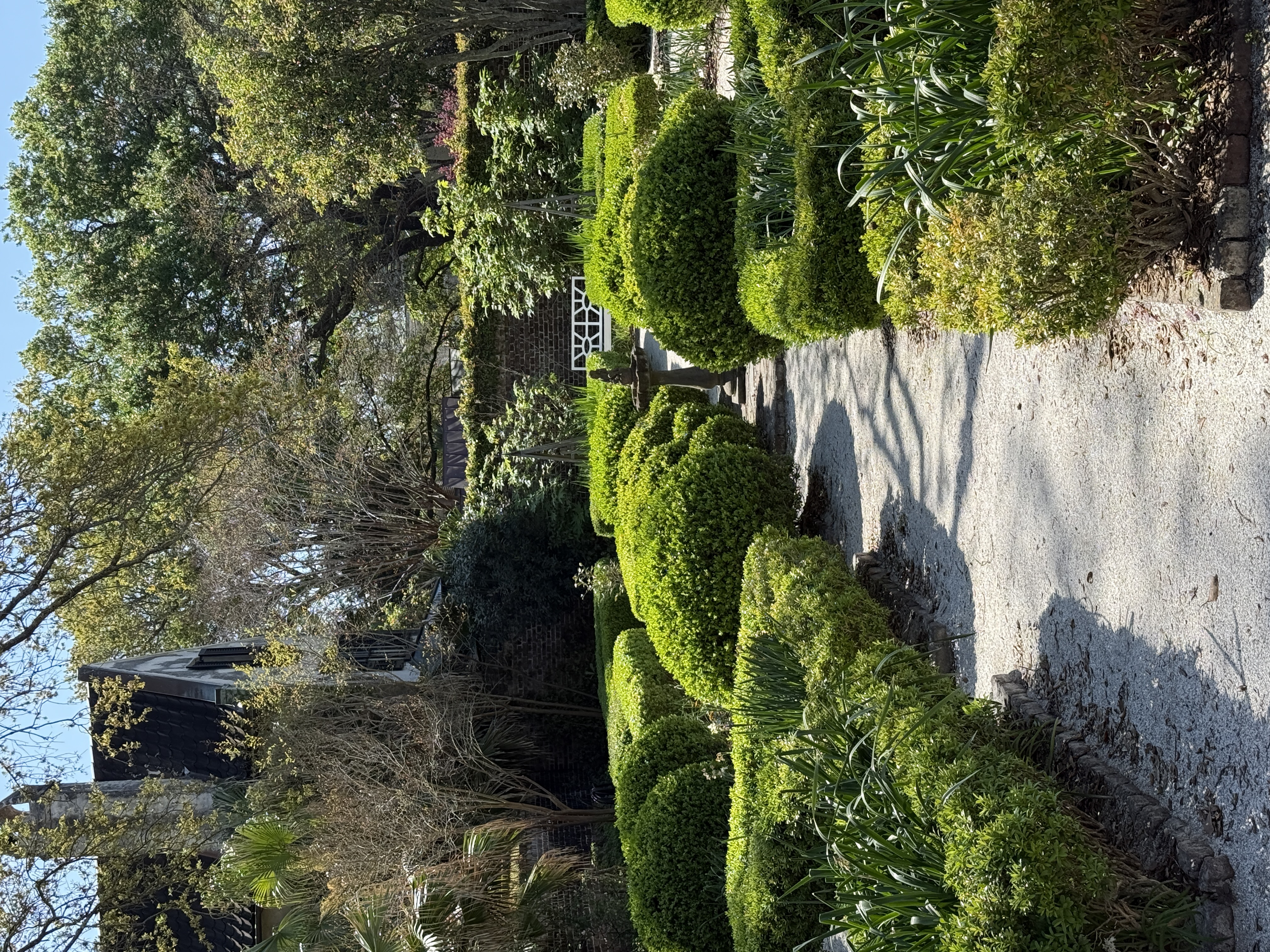 powerful as any exhibit within. The displays were thoughtful and moving, and the sculpture garden outside offered its own quiet eloquence. powerful as any exhibit within. The displays were thoughtful and moving, and the sculpture garden outside offered its own quiet eloquence.
From there, we boarded the boat for a box lunch and cruise on Charleston Harbor. Fort Sumter sat in the middle distance — the sea fort at the mouth of the harbor where the battle that sparked the American Civil War took place on April 12, 1861, when Confederate forces opened fire on the Union garrison and set four years of catastrophic conflict in motion. Viewed from the water, as it was meant to be seen, its presence is quietly arresting. Grand homes lined the coastline, and at times as many as five large dolphins appeared at the bow, surfing the boat's wake — an unexpected and joyful reminder that the natural world has its own agenda, indifferent to our itineraries.
The afternoon brought a different kind of immersion. We visited the Charleston Museum — founded in 1773 on the eve of the American Revolution and widely regarded as America's first museum, established by the Charleston Library Society — along with tours of several of the historic houses in its orbit. The Heyward-Washington House and Joseph Manigault House offered intimate windows into the domestic life of Charleston's founding-era elite.
The full weight of the city's layered history — Indigenous, colonial, enslaved, revolutionary, antebellum — accumulated over the course of the day. It was, in the best sense, an almost overwhelming day: the sheer concentration of significant history on every block, on every wharf, in every room. Charleston does not let you skim. It insists you reckon.
Day Six: Heading Home by Way of Fayetteville
An early morning departure marked our farewell to the Indigo Inn. Northbound on I-95, we made a stop that prompted strong reactions in both directions: Buc-ee's. For the uninitiated, Buc-ee's is a Texas-born phenomenon — part gas station, part small city — famous for its immaculate restrooms, wall-to-wall snacks, and sheer sensory abundance. For some it's a delightful slice of American road culture; for others, the scale and bustle can feel like rather a lot before noon. Either way, it's an experience, and on a long bus ride, that counts for something.
Our destination was Cape Fear Botanical Garden in Fayetteville, North Carolina — an 80-acre garden nestled between the Cape Fear River and Cross Creek that proved a wonderful surprise. We arrived just in time to experience near-record afternoon heat, which lent the shaded garden paths a particular appeal.
After lunch on the gift shop patio, our guide Bill oriented us to one of the garden's most distinctive features: its Heritage Garden, where a collection of historic agricultural structures has been relocated and preserved on the grounds. The complex includes an 1800s farmhouse, general store, corn crib, and smokehouse, offering visitors a window into the region's agricultural past. Among them, a 1930s tobacco barn — relocated from Eastover — prompted a discussion of tobacco curing. The three traditional methods are air curing, in which leaves hang in ventilated barns for weeks; flue curing, in which heat is piped in from external fireboxes without exposing the leaf to smoke; and fire curing, in which open wood fires on the barn floor impart a characteristic smoky aroma to the leaf. North Carolina's Piedmont region was historically flue-cured bright tobacco country, which gave the barn both local and agricultural resonance.
From there, the afternoon shifted from history to hands-on, as workshop leader Chad introduced us to the world of air plants. Tillandsias — epiphytes that require no soil, drawing moisture and nutrients directly from the air — are ideally suited to a glass terrarium, and that's exactly what we made. The species for the day was Tillandsia ionantha, with its green to reddish tendrils, sometimes frosted at the base with a silvery blush, and a purple shoot tipped with a small white-to-yellow flower when in bloom. From sand to stone to shells, each person assembled and decorated their small terrarium with their own creative spin — a genuinely satisfying exercise in miniature garden-making.
Everyone was happy to board the bus after a long, hot, and thoroughly enjoyable afternoon. The timing of Joanne's chocolate chip biscotti was, as always, impeccable.
Day Seven: An English Manor on the James
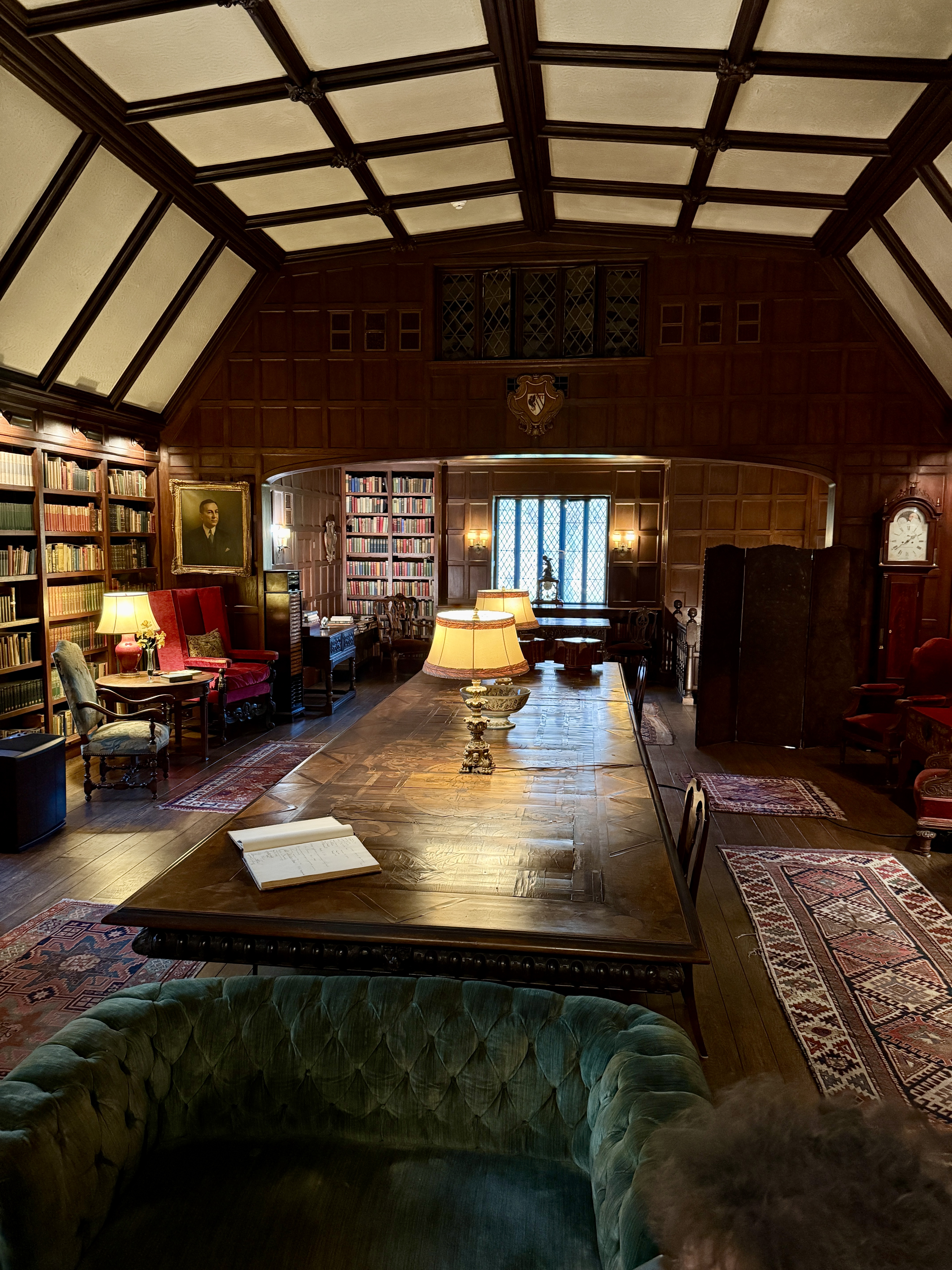 A welcome drop in temperature greeted us as we departed for Richmond, and the cooler air felt like a gift. Our destination was one of the most improbable houses in America: Agecroft Hall. A welcome drop in temperature greeted us as we departed for Richmond, and the cooler air felt like a gift. Our destination was one of the most improbable houses in America: Agecroft Hall.
A deed dated February 14, 1376 may be the earliest known mention of Agecroft in Lancashire, England, where it served as the manor home of distinguished families through much of the Tudor and Stuart eras. By the early 20th century, surrounded by coal mines and railway lines, the old house stood empty and deteriorating. In 1925, successful Richmond businessman T.C. Williams Jr. purchased the structure at auction and had a team of workers carefully dismantle the most intact portions of the manor and ship the pieces across the Atlantic to Richmond, where it was reassembled overlooking the banks of the James River. It is, in every sense, a house that traveled.
Though the Williams family lived here as a modern private home for four decades, when it opened as a museum in 1969 the rooms were furnished with authentic 16th and 17th-century English pieces to interpret Tudor domestic life — with one notable exception: Bessie's own 20th-century library, preserved exactly as she left it. The library holds some 3,000 volumes alongside a magnificent 18-foot refectory table of the kind more commonly found in the great halls of English monasteries and colleges.
Our guides Sylvia and Bill were engaging and well-versed. Along the way, Sylvia shared some etymology worth passing on. The origins of "chairman of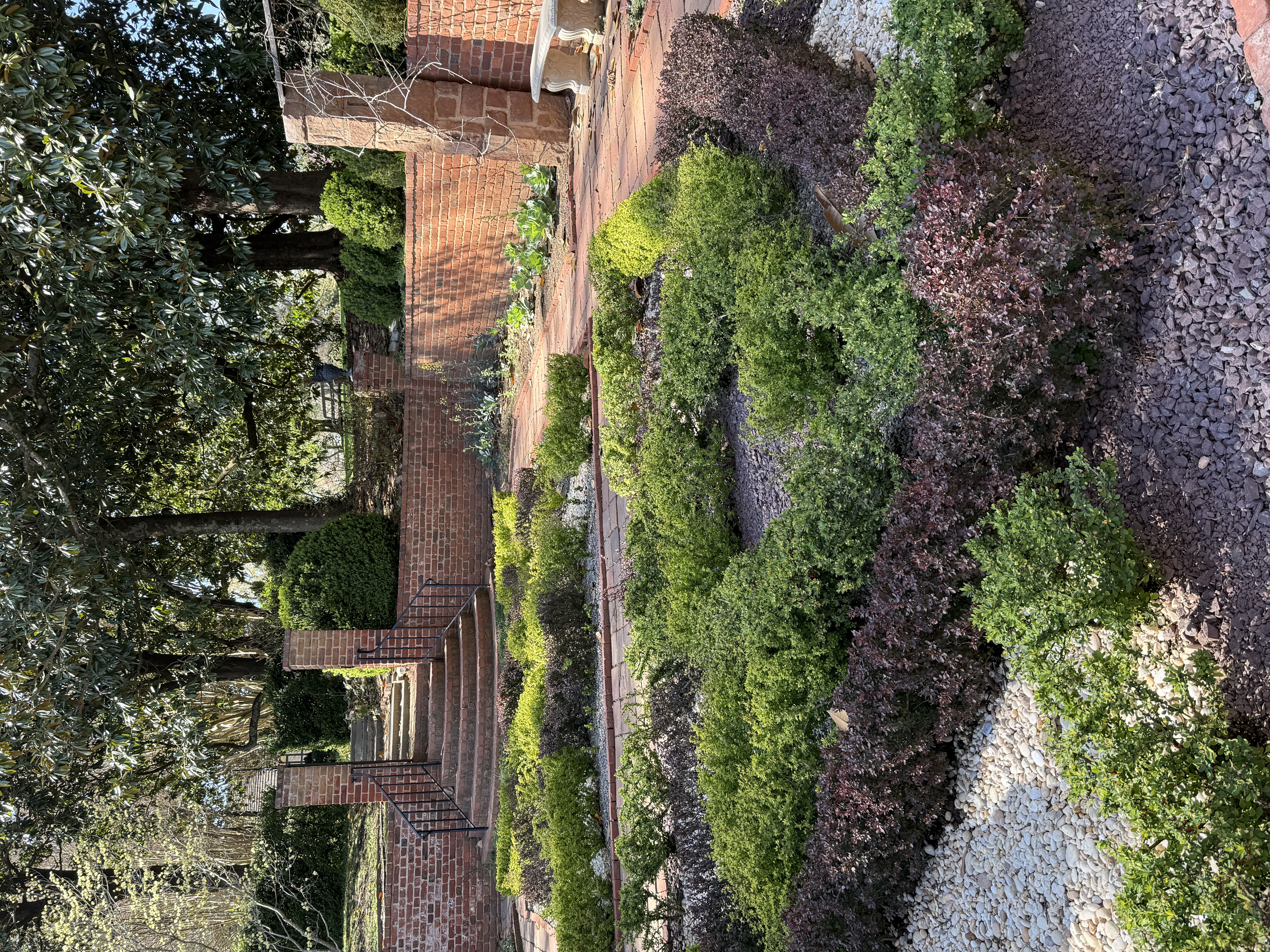 the board" and "room and board" both trace back to the Tudor board — the long plank table that was the center of household life. The head of the household sat in a chair at the board while everyone else sat on stools or benches, giving us "chairman of the board," and when an inn offered lodging and meals around that table, it offered "room and board." Standing in a Tudor dining room while hearing this made it land with particular force. the board" and "room and board" both trace back to the Tudor board — the long plank table that was the center of household life. The head of the household sat in a chair at the board while everyone else sat on stools or benches, giving us "chairman of the board," and when an inn offered lodging and meals around that table, it offered "room and board." Standing in a Tudor dining room while hearing this made it land with particular force.
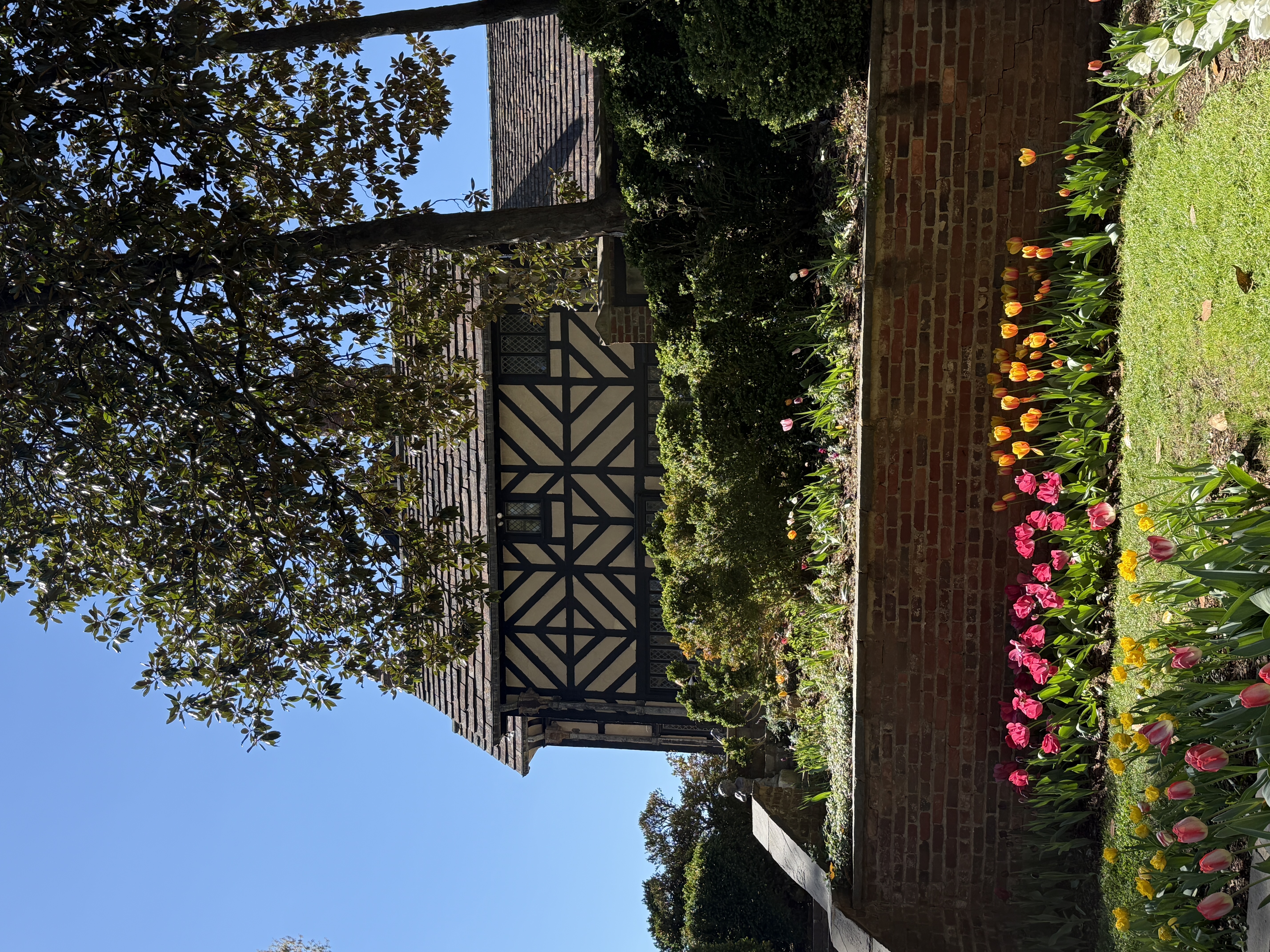 After the house tour, we stepped outside into the gardens. Elizabeth worked in close partnership with landscape architect Charles Gillette to create the terraces and sunken garden, inspired by designs at Hampton Court Palace. Gillette's guiding approach was to create garden "rooms" using masonry and native plant material to form separate, distinct spaces within the larger whole — a philosophy that feels entirely at home in the Tudor context. The grounds include a herb knot garden, an herb cutting garden, a turf maze, and a crape myrtle walk, with sweeping views of the James River along the property's edge. After the house tour, we stepped outside into the gardens. Elizabeth worked in close partnership with landscape architect Charles Gillette to create the terraces and sunken garden, inspired by designs at Hampton Court Palace. Gillette's guiding approach was to create garden "rooms" using masonry and native plant material to form separate, distinct spaces within the larger whole — a philosophy that feels entirely at home in the Tudor context. The grounds include a herb knot garden, an herb cutting garden, a turf maze, and a crape myrtle walk, with sweeping views of the James River along the property's edge.
And then there were the tulips. The sunken garden holds over 5,000 tulips in more than 90 varieties, and on this bright, chilly March day they were performing magnificently — reds, purples, creams and bicolors catching the light against the dark timbers of the old house above.
Day Eight: Bulbs, Blooms, and a Bittersweet Farewell
The final full day of the trip dawned crisp, sunny, and cool — as if the weather had decided to send us off properly. Our morning destination was one that needed no introduction for many in the group: Brent and Becky's Bulbs in Gloucester, Virginia, situated on Daffodil Lane overlooking the North River.
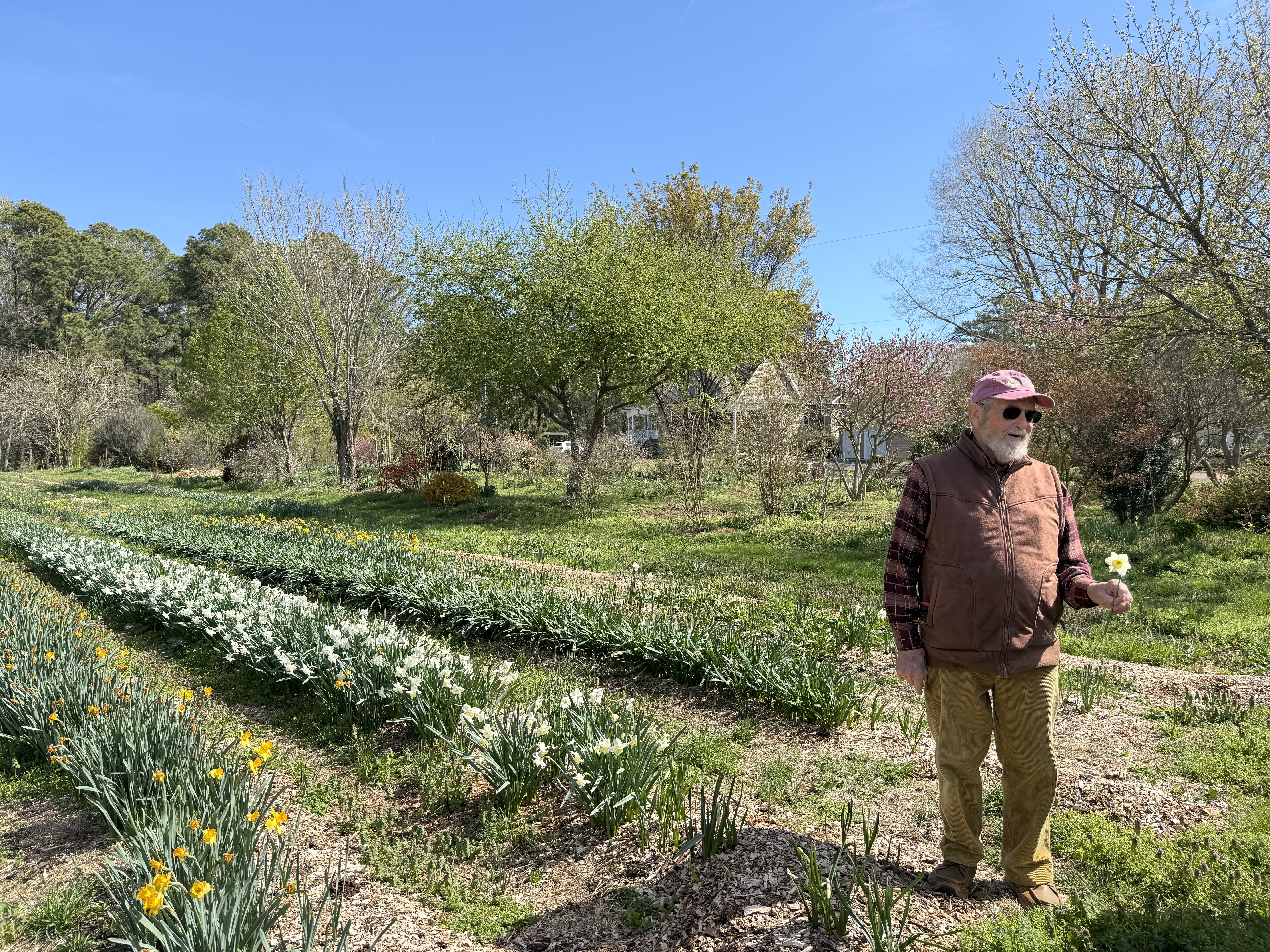 The business traces its roots to 1900, when Brent Heath's grandfather — a devoted lover of the daffodil — moved to Gloucester to start his farm. Now in its fourth generation, the operation is led by Brent and Becky Heath, who are not only bulb growers but garden writers, photographers, lecturers, and educators, with over eight acres of their 28-acre property devoted to educational display gardens demonstrating sustainable, chemical-free growing practices. Brent and Becky welcomed us warmly and personally, and their hospitality in sharing their family compound and gardens made for an exceptionally generous start to the day. For those who'd like to know more about how this remarkable enterprise came to be, the short video we were shown tells the story beautifully: https://youtu.be/3hRd4Wz4aYs The business traces its roots to 1900, when Brent Heath's grandfather — a devoted lover of the daffodil — moved to Gloucester to start his farm. Now in its fourth generation, the operation is led by Brent and Becky Heath, who are not only bulb growers but garden writers, photographers, lecturers, and educators, with over eight acres of their 28-acre property devoted to educational display gardens demonstrating sustainable, chemical-free growing practices. Brent and Becky welcomed us warmly and personally, and their hospitality in sharing their family compound and gardens made for an exceptionally generous start to the day. For those who'd like to know more about how this remarkable enterprise came to be, the short video we were shown tells the story beautifully: https://youtu.be/3hRd4Wz4aYs
The tour concluded with a visit to the Bulb Shoppe — and suffice it to say the bus was noticeably heavier on the return journey than it had been going in. If you feel you missed out, you haven't — Brent and Becky's ships nationwide and their knowledgeable staff are always happy to answer questions by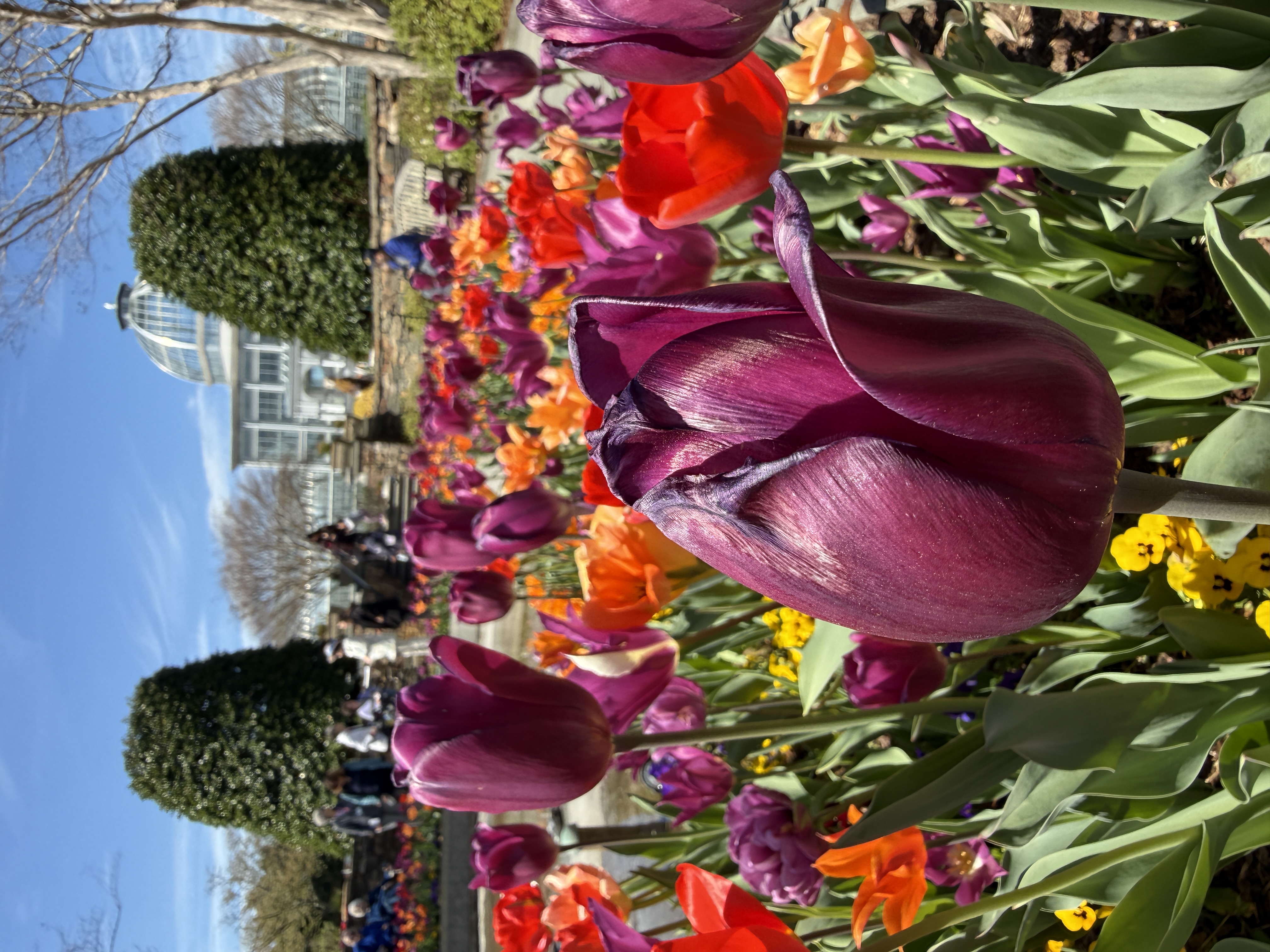 phone or online. phone or online.
The afternoon brought us to Lewis Ginter Botanical Garden, one of the finest public gardens in the mid-Atlantic. The garden was established in 1984 on land bequeathed to the City of Richmond by Grace Arents, who wished to honor her uncle, Lewis Ginter, the Richmond philanthropist and amateur horticulturist. Spanning more than 50 acres, the garden encompasses more than a dozen themed areas including a Rose Garden, Asian Valley, Children's Garden, and Cherry Tree Walk, anchored by a classical glass-domed Conservatory — the only one of its kind in the mid-Atlantic. The Conservatory itself was closed for extensive renovations, but on a warm, sunny afternoon with spring fully underway, the outdoor gardens were all the compensation needed.
The tulips were extraordinary. Row upon row of orange, burgundy, cream, and deep purple blooms filled the sunken terraced garden, reflected in the still water of the central pool, framed by dry-stacked stone walls and the bare limbs of trees just coming into leaf. As you can see from the photograph, words only go so far.
From the number of bags making their way back onto the bus, Lewis Ginter's gift shop also made a strong impression — a fitting last tribute to a group of people who never encountered a plant or garden accessory they didn't want to bring home.
After a short return to the hotel and a chance to freshen up, the group gathered one last time for happy hour — now, as Janice had predicted on that very first day, genuinely fast friends. Stories were swapped, photographs shared, and future garden adventures plotted with the particular enthusiasm of people who have just spent a week doing exactly what they love.
Day Nine: The Road Home
The final morning found us northbound and reflective, the bus a little fuller than it had been nine days earlier — in every sense of the word. Somewhere along the miles, Dawn Freeman presented our indefatigable tour leader, Janice Thomas, with a heartfelt gift and the group's wholehearted gratitude. And we gave our warm thanks once more to Rick Bandell — whose steady hands and easy manner had carried us safely through nearly a thousand miles of Lowcountry, Piedmont, and Virginia countryside.
Back at our departure point, we offloaded our treasures — bulbs, terrariums, garden accessories, and more than a few impulse purchases we don't regret in the slightest — and said our farewells. Old friendships had deepened over shared meals and garden gates; new ones had taken root just as surely. It is, perhaps, the finest thing a journey like this can do.
Final Notes from the Bus: Recipes and a Good Read
No trip this rich passes without its pleasures extending beyond the gardens themselves. Throughout our nine days, a devoted band of bakers kept spirits high and hunger at bay — their treats appearing at precisely the right moments, mile after mile. In the pages that follow, we've gathered their recipes so you can bring a little of the journey home. With gratitude to each of them.
Joanne Patti's Almond Olive Oil Biscotti
Ingredients
2 cups all-purpose flour
1½ tsp baking powder
¼ tsp kosher salt
¼ cup olive oil
⅔ cup granulated sugar
1 large egg plus 1 large egg yolk
2 tsp pure almond extract
1 tsp pure vanilla extract
1 tsp orange zest
½ cup toasted almonds, lightly crushed
Instructions
1. Preheat oven to 350°F. Line a large baking sheet with parchment.
2. Whisk together the flour, baking powder, and salt in a medium bowl.
3. In another medium bowl, whisk the olive oil and sugar together. Add the eggs, almond and vanilla extracts, and the orange zest. Whisk to combine.
4. Pour the olive oil mixture over the flour mixture. Add the almonds and, with a sturdy spoon, mix just until the flour is combined.
5. Place the dough onto a heavily floured surface. Roll it into a log about 10 inches long.
6. Carefully move the log onto the prepared baking sheet. Bake for 30 minutes.
7. Remove the log and allow it to cool for 15 minutes. Using a thin serrated knife, cut the log into ½-inch slices.
8. Place the slices on the baking sheet and return to the oven for 7 minutes. Turn the slices over and bake for an additional 5 minutes.
9. Allow the biscotti to cool on a wire rack before storing.
Liz Garnett's Easy Crunchies
A family recipe from Margaret Bowyer, Quadrille Quilters — "My grandmother gave this recipe to me, and I have yet to find one that beats it!" Makes approximately 30.
Ingredients
1 cup flour
2 cups oats
1 cup coconut
1 cup sugar
250g butter
1 Tbsp syrup
1 tsp bicarbonate of soda
Method
1. In a large bowl combine the flour, oats, sugar and coconut.
2. Heat the butter and syrup in a saucepan until the butter is melted. Do not boil.
3. Stir in the bicarbonate of soda and mix till frothy.
4. Add to dry ingredients and stir in with a fork.
5. Press lightly into a prepared Swiss roll tin.
6. Bake at 180°C (350°F) for 15 minutes.
7. Cut while hot.
Mary Haskins's Vanilla-Bean Sablé Cookies
Adapted from Dorie Greenspan, Fine Cooking. Yields about 2 dozen.
Once you've scraped the pulp from the vanilla beans, stash the pods in a canister of sugar to make vanilla sugar. You can substitute 2 tsp vanilla extract for the vanilla beans; add it with the egg yolk.
Ingredients
2 soft, plump vanilla beans
⅓ cup granulated sugar
8 oz (1 cup) unsalted butter, preferably high-fat European-style, softened
½ tsp fine sea salt
1⅓ oz (⅓ cup) confectioners' sugar, sifted
2 large egg yolks
9 oz (2 cups) unbleached all-purpose flour
Sanding sugar, white or colored
Method
1. Cut the vanilla beans in half lengthwise and scrape the seed pulp into a small bowl; add the granulated sugar. Using your fingers, rub them together until blended.
2. In a stand mixer fitted with the paddle attachment, mix the butter on low speed until smooth and creamy, about 1 minute. Mix in the salt, vanilla sugar, and confectioners' sugar until smooth, about 1 minute. Add 1 egg yolk and mix for 1 minute. Still on low speed, mix in the flour just until blended; the dough will be soft.
3. Turn the dough out onto the counter and knead it gently a few times. Divide it in half and shape each half into a 9-inch log. Wrap the logs in plastic wrap and refrigerate for at least 3 hours (or freeze for up to 2 months).
4. Position oven racks in the top and bottom thirds of the oven and heat to 350°F. Line two baking sheets with parchment or silicone liners.
5. Sprinkle about ½ cup sanding sugar onto a piece of waxed paper. Combine the remaining egg yolk with a splash of water and whisk with a fork. Brush each log with the egg wash and roll in the sanding sugar until evenly coated. Trim the ends if ragged. Using a knife, cut into ½-inch-thick rounds. Place on baking sheets, leaving about 2 inches between rounds.
6. Bake, rotating and swapping baking sheet positions halfway through, until the cookies are brown around the edges and golden on the bottom, 18 to 22 minutes. Let cool on the sheets for 5 minutes, then transfer to a cooling rack and let cool completely. Sablés shouldn't be eaten warm; they need to cool so that their texture sets properly.
Packed in an airtight container, the cookies will keep for at least 4 days.
Joanne Patti's Chocolate Chip Biscotti
Crisp, crunchy cookies with just a dip of chocolate — perfect with after-dinner coffee. Makes 6 dozen.
Prep: 10 minutes • Chill: 1 hour • Bake: 1 hour 10 minutes • Cool: 10 minutes
Ingredients
3 cups all-purpose flour
2½ tsp baking powder
½ tsp baking soda
½ tsp salt
½ cup butter or margarine, softened
1¼ cups sugar
3 eggs
¼ tsp almond extract
2 cups miniature chocolate chips, divided
Instructions
1. Coat baking sheets with nonstick cooking spray; set aside.
2. In a bowl, combine the flour, baking powder, baking soda, and salt.
3. In another bowl, beat the butter and sugar with a mixer on high for 2 minutes. Add the eggs and almond extract; beat 1 minute. Gradually stir in the flour mixture. Stir in 1 cup of the chocolate chips. Cover and chill 1 hour.
4. Preheat oven to 325°F. On a floured surface, divide the dough into thirds. Shape each third into a 1" x 10" roll. Place on prepared baking sheets; bake 30 minutes.
5. Remove from oven. Reduce oven temperature to 275°F. Slice rolls crosswise into ½" pieces. Place on baking sheets, cut side down. Bake 40 minutes more. Cool completely.
6. Meanwhile, in a saucepan over low heat, melt the remaining 1 cup chocolate chips; cool to room temperature. Dip one end of each cookie into the melted chocolate; place on wax paper until set.
7. Store in a tightly sealed container.
One More Thing Before You Go
If your appetite for the Lowcountry wasn't fully satisfied by nine days on the road, or by reading about our adventures, we have one book recommendation: The Indigo Girl by Natasha Boyd — a novel that brings the indigo history of the Carolina Lowcountry vividly to life through the story of Eliza Lucas Pinckney, the young woman who introduced indigo cultivation to the Carolina colonies in the 1740s. The suggestion comes from Darlene Snyder, and it is warmly seconded.
Written by Susan Sauter with assistance by Claude AI
|